The Court says that the 1A "studiously defines the manner, the specific ways, in which" Church and State shall be kept separate. (p. 1771) Where is that studious and specific list? Does the 1A even mention the idea of separation of church and state?
Now consider four different "time release" programs plus one more example of accommodation.
1. The one in Zorach, in which students (whose parents request) are released from one class per week to attend a religious program of their choice.
2. A Jewish student is granted an excused absence to observe Yom Kippur or a similar holy day.
3. A Catholic student's parents request that he or she be excused from a "mandatory assembly" on "safe sex" and STDs.
4. During Ramadan, a holy month of fasting and prayer for Muslims, NYC public schools release Muslim students from classes for 10 minutes per day and allow them to go to an empty classroom for communal prayer.
5. Recently, NYC public schools installed "foot baths" in rest rooms to accommodate Muslim students who need to wash their feet before prayer during Ramadan. Does this violate the EC?
Do any of these excusals violate the EC? Should they be struck down? Are any of them required by the Free Exercise Clause?
Wednesday, May 31, 2023
Religious Purpose and Facial vs. As Applied Challenges
In the Santa Fe case, did anyone ever pray or deliver an invocation at a football game? Which prayer? Which invocation? How did the Court know that an unspoken student statement, one that might have had secular content or might have had religious content, was somehow an establishment of religion?
We will never know what would have happened, will we? How did the Court know that some uncertain future expression, of unknown content, somehow constitutes an establishment of religion?
What was the move the Court used to strike down these laws without any record about what in fact might be said or left unsaid?
Notice that the Court's general rule about facial vs. as applied challenges is that facial attacks are disfavored if there is any possible application of a law that would be constitutional. Instead of invalidating a law root and branch, the Court will wait for unconstitutional applications of the law to come before it and will enjoin the unconstitutional applications, while permitting the constitutional applications to be given effect. See United States v. Salerno, 481 U.S. 739, 745 (1987) (a Pl bringing a facial challenge against a law "must establish that no set of circumstances exists under which the Act would be valid").
How does this rule apply in Santa Fe? Should the Court have waited to see how the policy would have been applied?
For more on the Lemon "purpose" prong, see here.
We will never know what would have happened, will we? How did the Court know that some uncertain future expression, of unknown content, somehow constitutes an establishment of religion?
What was the move the Court used to strike down these laws without any record about what in fact might be said or left unsaid?
Notice that the Court's general rule about facial vs. as applied challenges is that facial attacks are disfavored if there is any possible application of a law that would be constitutional. Instead of invalidating a law root and branch, the Court will wait for unconstitutional applications of the law to come before it and will enjoin the unconstitutional applications, while permitting the constitutional applications to be given effect. See United States v. Salerno, 481 U.S. 739, 745 (1987) (a Pl bringing a facial challenge against a law "must establish that no set of circumstances exists under which the Act would be valid").
How does this rule apply in Santa Fe? Should the Court have waited to see how the policy would have been applied?
For more on the Lemon "purpose" prong, see here.

County of Allegheny: How they Voted
- A. Creche Unconstitutional, Menorah Constitutional: Blackmun & O'Connor
- B. Both Unconstitutional: Stevens, Brennan & Marshall
- C. Both Constitutional: Kennedy, Scalia, Rehnquist & White
Thus, A plus B equals 5-4 decision that the creche is unconstitutional; and A plus C equals 6-3 decision that the menorah is constitutional,
Saturday, May 20, 2023
Allegheny and the "Secular State"
Consider this excerpt from Justice Blackmun's Majority opinion:
Is a secular state neutral between religious citizens and nonbelievers? Should public displays and memorials reflect the pluralism of a nation such as ours? Does a public square that contains only non-religious displays truly reflect the religious diversity of our Nation?
The government does not discriminate against any citizen on the basis of the citizen's religious faith if the government is secular in its functions and operations. On the contrary, the Constitution mandates that the government remain secular, rather than affiliate itself with religious beliefs or institutions, precisely in order to avoid discriminating among citizens on the basis of their religious faiths. A secular state, it must be remembered, is not the same as an atheistic or anti-religious state. A secular state establishes neither atheism nor religion as its official creed. Justice Kennedy thus has it exactly backwards when he says that enforcing the Constitution's requirement that government remain secular is a prescription of orthodoxy.
Is a secular state neutral between religious citizens and nonbelievers? Should public displays and memorials reflect the pluralism of a nation such as ours? Does a public square that contains only non-religious displays truly reflect the religious diversity of our Nation?
Thursday, April 27, 2023
Viewpoint Discrimination
What is the difference between "viewpoint discrimination" and "content"
or "subject matter" discrimination? This is an important distinction in
the law of free speech and public forums, because viewpoint
discrimination is prohibited in all types of fora, but subject matter
discrimination is permitted in certain types of fora.
Is the subject or topic the speaker wishes to address permitted? If so,
is the speaker being excluded from the forum only because of the
viewpoint or ideological perspective from which he or she wishes to
address the subject?
Here is a great quote from Prof. Michael McConnell on viewpoint discrimination:
"In my opinion, whether a restriction is
viewpoint discriminatory [depends upon the answer to the following]
realistic question: Are there any identifiable ideological groups of
thought that are put at a disadvantage relative to their competitors?
When religious speakers are excluded (even if 'religious' includes
atheists), their perspective is put at a disadvantage vis-a-vis dozens
of other competing worldviews. Thus, a person who thinks the welfare
reform bill is bad because it is contrary to Marxist theory can get
government money and proclaim his views, but the person who thinks it is
bad because it is contrary to Christ's admonition to feed the poor
cannot."
Why is Compelled Speech So Poisonous to the First Amendment
As Professor Robert George of Princeton University has said:
“Ordinary authoritarians are content to forbid people from saying things they know or believe to be true.
Totalitarians insist on forcing people to say things they know or believe to be untrue."
What point was Prof. George making there?
Saturday, April 22, 2023
Assignments for April 27 & 28
Thursday April 27: Compelled Speech & 303 Creative Preview :My Article on Viewpoint Compulsions
I am not assigning the oral argument, but it was a very good one. If you want to listen to it, it is here
Thursday, April 20, 2023
Assignments April 20 & 21
--Casebook p. 696-709; Bruen (link)
-- State Action: Casebook p. 1133-1146
Requirements for Students Taking This Class as a Seminar
The requirements for each seminar student are:
1. Participate in our class discussions;
2. Do a class presentation of your research paper;
3. Submit a reasonably detailed (at least 2 pages) executive summary of your paper by February 17, 2023;
4. Write a 25-35 page (double-spaced, with footnotes) research paper
(similar to a student law review comment or note) on a constitutional
law topic from the list provided.
You should focus on deep
analysis of the issues in your paper and your research should focus not
only on caselaw, but on the law review literature. You
should support your reasoning and conclusions with many footnotes
(probably at least 75 to 100 footnotes supporting the text) citing
cases, law review articles, books, and other legal sources. You should have a footnote supporting every factual statement you make, any idea you borrow from a court or a legal scholar, and every case you cite or discuss. You should discuss your topic
with me at your earliest convenience. You must get approval of your
topic from me. The paper will be due on or before April 28, 2023.
5. Here is a great book that might help you write your seminar paper:
Eugene
Volokh, Academic Legal Writing: Law Review Articles, Student Notes,
Seminar Papers, and Getting on Law Review. It is in its 5th edition, but
the earlier editions should be almost as helpful. I found a number of
inexpensive copies being offered on Ebay. Check Ebay before buying new at an exorbitant price. I also have placed a copy of this book on reserve on the law library.
Your grade for the course will be based 100% on the grade you receive on
your paper; however, your grade may be increased by one full point for
exceptionally good class attendance and participation (including an excellent
presentation of your paper).
The Right to Bear Arms as a Check on Tyranny
See p. 699 and its discussion of citizens' militias "consisting of all able-bodied men" as a check on tyranny.
What does this mean? Is an armed citizenry still needed as a check on tyranny and tyrants?
What should a free people do when government locks the doors of their places of worship or rounds up their children and raises them in state institutions?
But this will never happen in our world, will it?
Wednesday, April 19, 2023
Right to Carry Case, Bruen, Decided
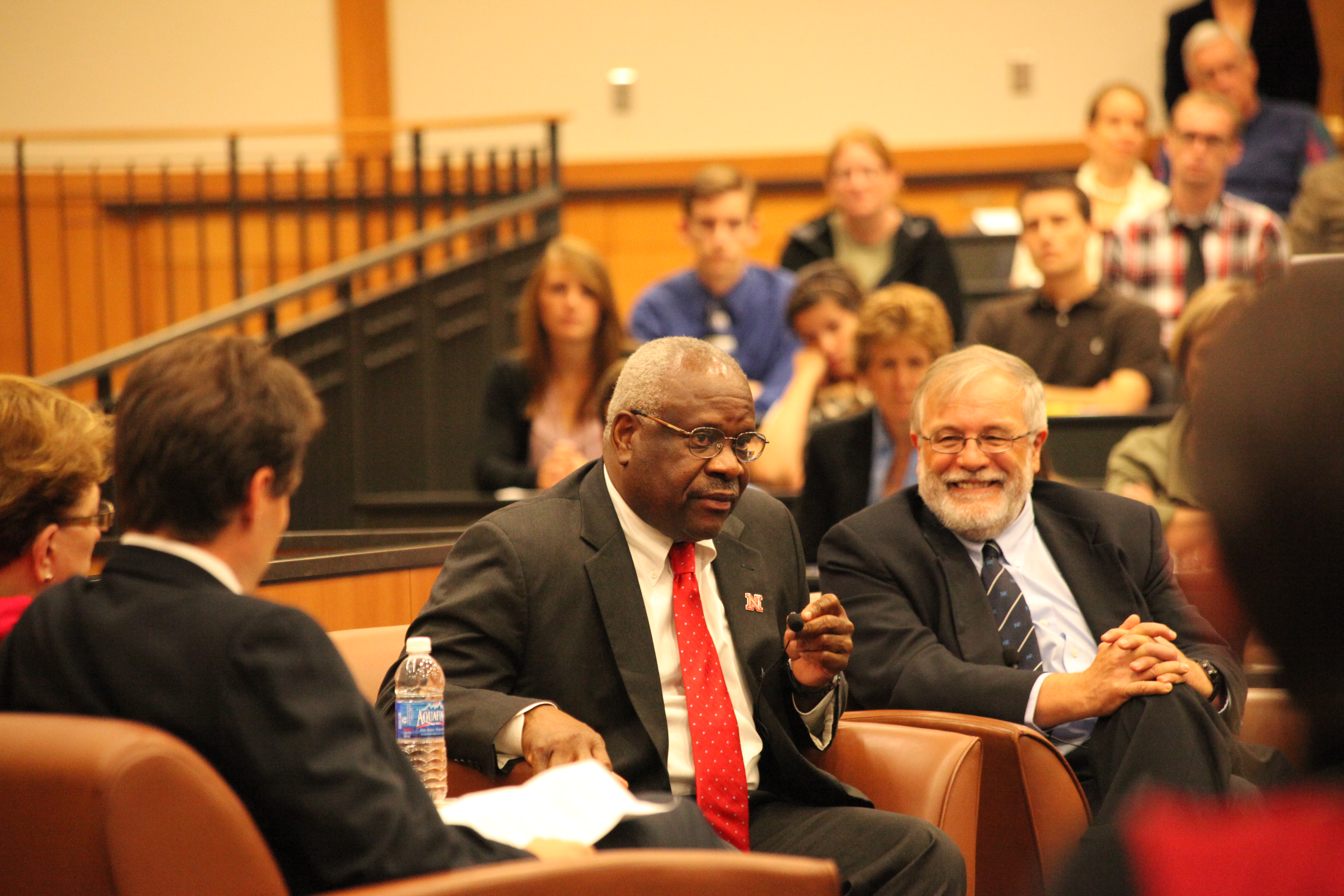
Lions in Winter
Justice Thomas writes for a 6 to 3 majority!
Here are some important passges:
Holding:
In District of Columbia v. Heller (2008) and McDonald v. Chicago (2010), we recognized that the Second and Fourteenth Amendments protect the right of an ordinary, law-abiding citizen to possess a handgun in the home for self-defense. In this case, petitioners and respondents agree that ordinary, law-abiding citizens have a similar right to carry handguns publicly for their self-defense. We too agree, and now hold, consistent with Heller and McDonald, that the Second and Fourteenth Amendments protect an individual’s right to carry a handgun for self-defense outside the home.
Thus, New York's requirement that law-abiding citizens would be issued a permit to carry only when they "demonstrate a special need for self-defense" is unconstitutional.
Test:
In Heller and McDonald, we held that the Second and Fourteenth Amendments protect an individual right to keep and bear arms for self-defense. In doing so, we held unconstitutional two laws that prohibited the possession and use of handguns in the home. In the years since, the Courts of Appeals have coalesced around a “two-step” framework for analyzing Second Amendment challenges that combines history with means-end scrutiny.
Today, we decline to adopt that two-part approach. In keeping with Heller, we hold that when the Second Amendment’s plain text covers an individual’s conduct, the Constitution presumptively protects that conduct. To justify its regulation, the government may not simply posit that the regulation promotes an important interest. Rather, the government must demonstrate that the regulation is consistent with this Nation’s historical tradition of firearm regulation. Only if a firearm regulation is consistent with this Nation’s historical tradition may a court conclude that the individual’s conduct falls outside the Second Amendment’s “unqualified command.”...
We reiterate that the standard for applying the Second Amendment is as follows: When the Second Amendment’s plain text covers an individual’s conduct, the Constitution presumptively protects that conduct. The government must then justify its regulation by demonstrating that it is consistent with the Nation’s historical tradition of firearm regulation. Only then may a court conclude that the individual’s conduct falls outside the Second Amendment’s “unqualified command."
This is a categorical rule with historical carve-outs.
Sensitive Place Historical Carve-out:
Much like we use history to determine which modern “arms” are protected by the Second Amendment, so too does history guide our consideration of modern regulations that were unimaginable at the founding. When confronting such present-day firearm regulations, this historical inquiry that courts must conduct will often involve reasoning by analogy—a commonplace task for any lawyer or judge. Like all analogical reasoning, determining whether a historical regulation is a proper analogue for a distinctly modern firearm regulation requires a determination of whether the two regulations are “relevantly similar.”
While we do not now provide an exhaustive survey of the features that render regulations relevantly similar under the Second Amendment, we do think that Heller and McDonald point toward at least two metrics: how and why the regulations burden a law-abiding citizen’s right to armed self-defense. As we stated in Heller and repeated in McDonald, “individual self-defense is ‘the central component’ of the Second Amendment right.”
To be clear, analogical reasoning under the Second Amendment is neither a regulatory straightjacket nor a regulatory blank check. On the one hand, courts should not “uphold every modern law that remotely resembles a historical analogue,” because doing so “risk[s] endorsing outliers that our ancestors would never have accepted.” On the other hand, analogical reasoning requires only that the government identify a well-established and representative historical analogue, not a historical twin. So even if a modern-day regulation is not a dead ringer for historical precursors, it still may be analogous enough to pass constitutional muster.
Consider, for example, Heller’s discussion of “longstanding” “laws forbidding the carrying of firearms in sensitive places such as schools and government buildings.” Although the historical record yields relatively few 18th- and 19th-century “sensitive places” where weapons were altogether prohibited—e.g., legislative assemblies, polling places, and courthouses—we are also aware of no disputes regarding the lawfulness of such prohibitions. We therefore can assume it settled that these locations were “sensitive places” where arms carrying could be prohibited consistent with the Second Amendment. And courts can use analogies to those historical regulations of “sensitive places” to determine that modern regulations prohibiting the carry of firearms in new and analogous sensitive places are constitutionally permissible.
Although we have no occasion to comprehensively define “sensitive places” in this case, we do think respondents err in their attempt to characterize New York’s proper-cause requirement as a “sensitive-place” law. In their view, “sensitive places” where the government may lawfully disarm law-abiding citizens include all “places where people typically congregate and where law-enforcement and other public-safety professionals are presumptively available.” Put simply, there is no historical basis for New York to effectively declare the island of Manhattan a “sensitive place” simply because it is crowded and protected generally by the New York City Police Department.....
The constitutional right to bear arms in public for self-defense is not “a second-class right, subject to an entirely different body of rules than the other Bill of Rights guarantees.” McDonald, 561 U. S., at 780 (plurality opinion). We know of no other constitutional right that an individual may exercise only after demonstrating to government officers some special need. That is not how the First Amendment works when it comes to unpopular speech or the free exercise of religion. It is not how the Sixth Amendment works when it comes to a defendant’s right to confront the witnesses against him. And it is not how the Second Amendment works when it comes to public carry for self-defense.
New York’s proper-cause requirement violates the Fourteenth Amendment in that it prevents law-abiding citizens with ordinary self-defense needs from exercising their right to keep and bear arms. We therefore reverse the judgment of the Court of Appeals and remand the case for further proceedings consistent with this opinion.
Tuesday, April 18, 2023
Scalia on Balancing Tests
Consider Justice Scalia's critique of balancing tests:
Scalia's latest criticism of judicial balancing tests was his shot in Heller at Breyer's "judge-empowering 'interest balancing inquiry' that 'asks whether the statute burdens a protected interest in a way or to an extent that is out of proportion to the statute's salutary effects upon other governmental interests.'" (p. 702)
He goes on to say that: "A constitutional guarantee subject to future judges' assessments of its usefulness is no constitutional guarantee at all." (p. 703)
Do you see the problem? How do you balance the state's interest in a particular policy against an individual's right to a particular liberty? How "heavy" is the interest and how long is the "right?" Is a 100 pound governmental interest heavier than an individual right that is 100 feet is long? Where in the written Constitution is the table of scales and measures? Or are balancing tests inherently subjective, judge-empowering tests rather than tests designed to interpret the actual meaning of the text of the Constitution?
This process is ordinarily called “balancing,” but the scale analogy is not really appropriate, since the interests on both sides are incommensurate. It is more like judging whether a particular line is longer than a particular rock is heavy.Bendix Autolite Corp. v Midwesco Enterprises, 486 U.S. 888, 897 (1988)
Scalia's latest criticism of judicial balancing tests was his shot in Heller at Breyer's "judge-empowering 'interest balancing inquiry' that 'asks whether the statute burdens a protected interest in a way or to an extent that is out of proportion to the statute's salutary effects upon other governmental interests.'" (p. 702)
He goes on to say that: "A constitutional guarantee subject to future judges' assessments of its usefulness is no constitutional guarantee at all." (p. 703)
Do you see the problem? How do you balance the state's interest in a particular policy against an individual's right to a particular liberty? How "heavy" is the interest and how long is the "right?" Is a 100 pound governmental interest heavier than an individual right that is 100 feet is long? Where in the written Constitution is the table of scales and measures? Or are balancing tests inherently subjective, judge-empowering tests rather than tests designed to interpret the actual meaning of the text of the Constitution?
Originalism and the Right to Bear Arms--Antique Muskets Only?

The Heller decision, also notes that "the Second Amendment extends, prima facie, to all instruments that constitute bearable arms, even those that were not in existence at the time of the founding." (p. 698)
Is this a rejection of original understanding by a Court purporting to apply originalism? Consider Justice Scalia's explanation (in a portion of the above quotation edited from the casebook):
Some have made the argument, bordering on the frivolous, that only those arms in existence in the 18th century are protected by the Second Amendment. We do not interpret constitutional rights that way. Just as the First Amendment protects modern forms of communication, and the Fourth Amendment applies to modern forms of search, the Second Amendment extends, prima facie, to all instruments that constitute bearable arms, even those that were not in existence at the time of the founding.
In other words, originalism discerns the principle that defines the liberty, which then must be applied to modern threats against that liberty.
Does that make more sense? Does it demonstrate how the original understanding of constitutional liberties can be applied in modern cases?
By the way, here is how the Court described its search for original meaning:
The Second Amendment provides: “A well regulated Militia, being necessary to the security of a free State, the right of the people to keep and bear Arms, shall not be infringed.” In interpreting this text, we are guided by the principle that “[t]he Constitution was written to be understood by the voters; its words and phrases were used in their normal and ordinary as distinguished from technical meaning.” Normal meaning may of course include an idiomatic meaning, but it excludes secret or technical meanings that would not have been known to ordinary citizens in the founding generation.
Here are some other important passages from Heller:
1. The Prefatory Clause
The Second Amendment is naturally divided into two parts: its prefatory clause and its operative clause. The former does not limit the latter grammatically, but rather announces a purpose. The Amendment could be rephrased, “Because a well regulated Militia is necessary to the security of a free State, the right of the people to keep and bear Arms shall not be infringed.” Although this structure of the Second Amendment is unique in our Constitution, other legal documents of the founding era, particularly individual-rights provisions of state constitutions, commonly included a prefatory statement of purpose.
Logic demands that there be a link between the stated purpose and the command.... But apart from that clarifying function, a prefatory clause does not limit or expand the scope of the operative clause. “It is nothing unusual in acts … for the enacting part to go beyond the preamble; the remedy often extends beyond the particular act or mischief which first suggested the necessity of the law.” Therefore, while we will begin our textual analysis with the operative clause, we will return to the prefatory clause to ensure that our reading of the operative clause is consistent with the announced purpose.
2. Individual Right
As we will describe below, the “militia” in colonial America consisted of a subset of “the people”—those who were male, able bodied, and within a certain age range. Reading the Second Amendment as protecting only the right to “keep and bear Arms” in an organized militia therefore fits poorly with the operative clause’s description of the holder of that right as “the people.”We start therefore with a strong presumption that the Second Amendment right is exercised individually and belongs to all Americans.
3. Keep and Bear Arms
At the time of the founding, as now, to “bear” meant to “carry.” When used with “arms,” however, the term has a meaning that refers to carrying for a particular purpose—confrontation....Although the phrase implies that the carrying of the weapon is for the purpose of “offensive or defensive action,” it in no way connotes participation in a structured military organization. From our review of founding-era sources, we conclude that this natural meaning was also the meaning that “bear arms” had in the 18th century. In numerous instances, “bear arms” was unambiguously used to refer to the carrying of weapons outside of an organized militia. The most prominent examples are those most relevant to the Second Amendment : Nine state constitutional provisions written in the 18th century or the first two decades of the 19th, which enshrined a right of citizens to “bear arms in defense of themselves and the state” or “bear arms in defense of himself and the state.” It is clear from those formulations that “bear arms” did not refer only to carrying a weapon in an organized military unit...
4. Relationship Between Prefatory Clause and Operative Clause
We reach the question, then: Does the preface fit with an operative clause that creates an individual right to keep and bear arms? It fits perfectly, once one knows the history that the founding generation knew and that we have described above. That history showed that the way tyrants had eliminated a militia consisting of all the able-bodied men was not by banning the militia but simply by taking away the people’s arms, enabling a select militia or standing army to suppress political opponents. This is what had occurred in England that prompted codification of the right to have arms in the English Bill of Rights.It is therefore entirely sensible that the Second Amendment ’s prefatory clause announces the purpose for which the right was codified: to prevent elimination of the militia. The prefatory clause does not suggest that preserving the militia was the only reason Americans valued the ancient right; most undoubtedly thought it even more important for self-defense and hunting. But the threat that the new Federal Government would destroy the citizens’ militia by taking away their arms was the reason that right—unlike some other English rights—was codified in a written Constitution....
5. Limits of Holding
Like most rights, the right secured by the Second Amendment is not unlimited. From Blackstone through the 19th-century cases, commentators and courts routinely explained that the right was not a right to keep and carry any weapon whatsoever in any manner whatsoever and for whatever purpose. For example, the majority of the 19th-century courts to consider the question held that prohibitions on carrying concealed weapons were lawful under the Second Amendment or state analogues. Although we do not undertake an exhaustive historical analysis today of the full scope of the Second Amendment , nothing in our opinion should be taken to cast doubt on longstanding prohibitions on the possession of firearms by felons and the mentally ill, or laws forbidding the carrying of firearms in sensitive places such as schools and government buildings, or laws imposing conditions and qualifications on the commercial sale of arms.
We also recognize another important limitation on the right to keep and carry arms. Miller said, as we have explained, that the sorts of weapons protected were those “in common use at the time.” We think that limitation is fairly supported by the historical tradition of prohibiting the carrying of “dangerous and unusual weapons.”
Heller as an Example of Original Understanding
Amendment II
A well regulated militia, being necessary to the security of a free state, the right of the people to keep and bear arms, shall not be infringed.
Notice that both the majority opinion and the principle dissent in Heller purport to be applying original understanding in interpreting the Second Amendment. Notice that the majority specifically held that "In interpreting this text [the Second Amendment], we are guided by the principle that '[t]he Constitution was written to be understood by the voters; its words and phrases were used in their normal and ordinary as distinguished from technical meaning.'" In other words, the interpretation to be searched for is the meaning that would have been understood by "ordinary citizens in the founding generation." (Heller majority opinion, 128 S. Ct. at 2788, edited from casebook).
Notice that the competing sides most clearly differ on the relationship between the prefatory clause ("A well regulated militia, being necessary to the security of a free state") and the operative clause ("the right of the people to keep and bear arms, shall not be infringed").
How does Justice Scalia interpret this issue? (See p. 699-700)
How about Justice Stevens? (p.704-705)
Is there a difference between the Second Amendment as written and one that might provide:
"The right of certain people to keep and bear arms while serving in a well regulated militia shall not be infringed."
Which weapons are covered by the individual right to keep and bear arms? (see p. 709: those "typically possessed by law-abiding citizens for lawful purposes").
Notice that the right is also subject to "longstanding prohibitions on the possession of firearms by felons and the mentally ill, or laws forbidding the carrying of firearms in sensitive places such as schools and government buildings, or laws imposing conditions and qualifications on the commercial sale of arms." p. 701).
Friday, April 07, 2023
Seminar Students: Seminar Paper Presentations
Here are the dates to sign up for your presentations. Plan about 25 minutes to explain your thesis and analyze the issues. Then we will have 10 minutes for questions and comments. Please send me an email with your top 3 choices for dates. Here are the dates:
Friday March 31
1. Austen Sellers (Stare Decisis post-Dobbs)
2. Austin Rodgers (Carson v. Makin: school choice )
Friday April 7
1. Preston Koehler (Second Amendment)
2. Drew Bydalek (303 Creative v. Elenis)
Thursday April 13 (we will go until 4:45 or 5 PM)
1.Tyrone Fahie (race-based preferences)
2. Zach Schwindt (B. P. J. v. W. Virginia State Bd. of Educ, equal protection and transgender issues in sports)
3. Adam Gasway (Religious Flags on Government Flagpoles)
Friday April 14
No Class
Friday, March 31, 2023
Alienage and Equal Protection: A Brief Summary
Here is the Executive Summary:
The Court treats alienage as a suspect classification and thus applies strict scrutiny to most state and local laws that discriminate on the basis of alienage. For example, in Graham v. Richardson the Court struck down welfare laws that denied benefits if the applicant was a resident alien. P. 902
There is, however, an exception to this rule—the political function doctrine-- which allows states to “exclude aliens from positions intimately related to the process of democratic self-government.” See Bernal at 904. Thus, the state may bar aliens from serving as police officers, probation officers, and public school teachers, because these are jobs that involve discretionary power involving a basic governmental function. But not lawyers or notaries public. See 2-part test at p. 905.
Another exception involves classifications based upon alienage under federal law. These get only rational basis review. The reason for this is set forth in the Diaz case on p. 908 – “the responsibility for regulating the relationship between the United States and our alien visitors has been committed to the political branches of the Federal Government.” (See Art. 1, § 8 – power to establish a “Uniform Rule of Naturalization”).
Thursday, March 30, 2023
Schedule
No class next Thursday April 6. I will be on my way back from a speaking tour oat B.C. and Suffolk Law on school choice and the First Amendment.
Parents Involved v. Seattle School District (p. 887)
From Oyez:
Facts of the case
The Seattle School District allowed students to apply to any high school in the District. Since certain schools often became oversubscribed when too many students chose them as their first choice, the District used a system of tiebreakers to decide which students would be admitted to the popular schools. The second most important tiebreaker was a racial factor intended to maintain racial diversity. If the racial demographics of any school's student body deviated by more than a predetermined number of percentage points from those of Seattle's total student population (approximately 40% white and 60% non-white), the racial tiebreaker went into effect. At a particular school either whites or non-whites could be favored for admission depending on which race would bring the racial balance closer to the goal.
A non-profit group, Parents Involved in Community Schools (Parents), sued the District, arguing that the racial tiebreaker violated the Equal Protection Clause of the Fourteenth Amendment as well as the Civil Rights Act of 1964 and Washington state law. A federal District Court dismissed the suit, upholding the tiebreaker. On appeal, a three-judge panel the U.S. Court of Appeals for the Ninth Circuit reversed.
Under the Supreme Court's precedents on racial classification in higher education, Grutter v. Bollinger and Gratz v. Bollinger, race-based classifications must be directed toward a "compelling government interest" and must be "narrowly tailored" to that interest. Applying these precedents to K-12 education, the Circuit Court found that the tiebreaker scheme was not narrowly tailored. The District then petitioned for an "en banc" ruling by a panel of 11 Ninth Circuit judges. The en banc panel came to the opposite conclusion and upheld the tiebreaker. The majority ruled that the District had a compelling interest in maintaining racial diversity. Applying a test from Grutter, the Circuit Court also ruled that the tiebreaker plan was narrowly tailored, because 1) the District did not employ quotas, 2) the District had considered race-neutral alternatives, 3) the plan caused no undue harm to races, and 4) the plan had an ending point.
Question
1) Do the decisions in Grutter v. Bollinger and Gratz v. Bollinger apply to public high school students?
2) Is racial diversity a compelling interest that can justify the use of race in selecting students for admission to public high schools?
3) Does a school district that normally permits a student to attend the high school of her choice violate the Equal Protection Clause by denying the student admission to her chosen school because of her race in an effort to achieve a desired racial balance?
Conclusion
No, no, and yes. By a 5-4 vote, the Court applied a "strict scrutiny" framework and found the District's racial tiebreaker plan unconstitutional under the Equal Protection Clause of the Fourteenth Amendment. Chief Justice John Roberts wrote in the plurality opinion that "The way to stop discrimination on the basis of race is to stop discriminating on the basis of race." The Court acknowledged that it had previously held that racial diversity can be a compelling government interest in university admissions, but it ruled that "[t]he present cases are not governed by Grutter." Unlike the cases pertaining to higher education, the District's plan involved no individualized consideration of students, and it employed a very limited notion of diversity ("white" and "non-white"). The District's goal of preventing racial imbalance did not meet the Court's standards for a constitutionally legitimate use of race: "Racial balancing is not transformed from 'patently unconstitutional' to a compelling state interest simply by relabeling it 'racial diversity.'" The plans also lacked the narrow tailoring that is necessary for race-conscious programs. The Court held that the District's tiebreaker plan was actually targeted toward demographic goals and not toward any demonstrable educational benefit from racial diversity. The District also failed to show that its objectives could not have been met with non-race-conscious means. In a separate opinion concurring in the judgment, Justice Kennedy agreed that the District's use of race was unconstitutional but stressed that public schools may sometimes consider race to ensure equal educational opportunity.
Con Law II Spring 2023: Assignment March 30 & 31
Thursday March 30: Casebook p. 887-901; [Discuss Harvard and UNC cases]; Casebook p. 901-910
Friday Students Present Their Seminar Papers
Wednesday, March 29, 2023
Seattle School Decision
Here are a few points for us to discuss in class:
- In Grutter, although the Court upheld racial educational diversity as a compelling state interest, it explicitly stated that the use of racial classifications to achieve " outright racial balancing...is patently unconstitutional." p. 859 Did the student assignment plans in Seattle School amount to racial balancing or were they narrowly tailored to achieve educational diversity?
- See p.889 and its discussion of Grutter--did the pupil assignment plan in Seattle School make a holistic, individualized assessment of each student and employ race only "as part of a broader assessment of diversity, and not simply an effort to achieve racial balance"?
- Is the basic difference between the dissent and the majority one over the standard of review? In other words, is the Majority properly applying strict scrutiny and the Dissent in effect saying that a lower, more deferential, standard of review should be employed to evaluate "good" uses of race? How do we know which uses of race are good and which are not good?
- A personal note: I have a friend--a law professor who has argued powerfully in print in support of race-conscious student assignment plans for the public schools (much like the ones in this case); and this professor recently visited for a year at a law school in a large urban area, and planned to rent a very nice house located in a very nice neighborhood near the law school. However, when she discovered that her children would not be assigned to the very good neighborhood school, but rather would be assigned on account of their race and bussed to an inner-city school for the purpose of racial balancing, she refused to rent the house and rented alternative housing and made other school arrangements for her children. When I asked her about this--and suggested cheerfully that she had rejected a wonderful opportunity to live out her own theory of the good life--she got annoyed with me and said: "There is always an exception for your own children." What do you think of this kind of reasoning? If there is always an exception for the children of elite law professors, is there also always an exception for the children of non-elite others, such as the parents in Jefferson County who wished their children to attend a school located one mile from home rather than one located 10 miles from home? See p.888
- Notice both the Majority and the Dissent claim the mantle of Brown in support of their arguments. One side says Brown is best understood as standing for the principle that children should not be assigned to public schools on the basis of their race. The other side says Brown is best understood as permitting racial assignments so long as they are being employed to achieve greater integration. Whom do you think has the better of this argument? Martha Nussbaum says that Chief Justice Roberts failed to understand the difference between using race "to include or exclude." But, of course, when pupils are denied a school assignment on the basis of race, even if the purpose is some notion of good racial balancing, the effect is still to exclude that child on the basis of her race from a school she is otherwise qualified to attend. No?
- Although Chief Justice Roberts normally speaks with a soft voice, here is rhetoric is strong: "The way to stop discrimination on the basis of race is to stop discriminating on the basis of race." (P. 892).
- Now consider Justice Thomas accusing the dissent of "replicating" the arguments made by the "segregationists" defending segregated schools in Brown! He explicitly endorses a "color-blind Constitution." (p. 893)
-
 Jack Phillips of Masterpiece Cakeshop (art by Joshua Duncan) "We may not shelter in place when the C...
 -
From Volokh Blog: Brown v. Buhman and Bestiality By Eugene Kontorovich on December 16, 2013 4:16 am in Constitutional La...
-
I. Tinker A student's right to speak (even on controversial subjects such as war) in the cafeteria, the playing field, or "on the...