“When people get used to preferential treatment, equal treatment seems like discrimination.” - Thomas Sowell
Wednesday, August 31, 2022
Friday, July 22, 2022
Dave Chappell on Cancel Culture and Freedom of Expression
"The more you say I can't say something, the more urgent it is for me to say it....It has everything to do with my right, my freedom of artistic expression."

Monday, July 04, 2022
Scalia: The Constitution Says What it Says, and It Doesn't Say What It Doesn't Say
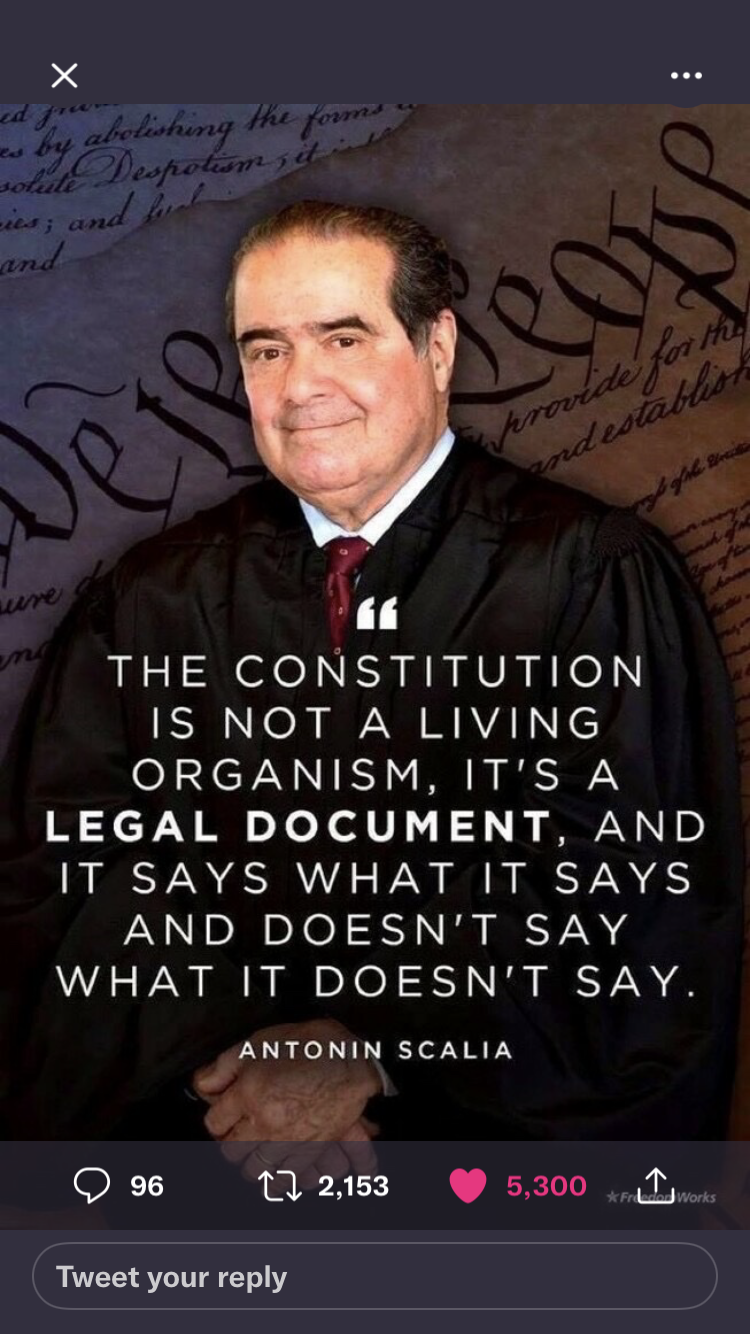
The best way to read SCOTUS cases in constitutional law is to ask what question is the Court trying to answer? Is the Court trying to answer the question "what does the Written Constitution say about this issue?" Or "what should a hypothetical constitution say about this issue?"
The former is the proper work of the judiciary. The latter is the work of the People via the amendment process.
Saturday, July 02, 2022
What I Am Reading This Summer
Ryan T. Anderson and Alexandra DeSanctis, Tearing Us Apart: How Abortion Harms Everything and Solves Nothing.
This book has my highest rating! Here is a link to Amazon.
Friday, July 01, 2022
Erika Bachiochi in NYT on "What Makes a Fetus a Person?"
Here is the link to Ms. Bachiochi's article. And here is a money quotation:
Dobbs v. Jackson has returned the issue of abortion to legislatures. There, pro-lifers will work to ensure that unborn children in every jurisdiction are protected by law. Though individual states can (and already have) sought to protect the most vulnerable human beings through ordinary legislation, constitutional protection of unborn children as equal “persons” under the law remains the movement’s ultimate — if elusive — goal.
Making this constitutional case will require rejecting the concept that a rights-bearing person is fundamentally self-owning and autonomous. Indeed, it is precisely the unborn child’s state of existential dependence upon its mother, not its autonomy, that makes it especially entitled to care, nurture and legal protection too. To exclude some human beings from the law’s protection because of their size, location and state of dependency (and post Roe, whichever jurisdiction their mother happens to be in) seems to pro-lifers an egregious human rights violation, just the kind we believe the 14th Amendment was meant to prevent.
If you are interested in where we might be going in a post-Roe world, read her entire article in the Times.
Thursday, June 30, 2022
Another Important SCOTUS Decision: West Virginia v. EPA
Another important case decided today.
The Supreme Court sharply limited the power of the EPA to enact regulations without Congressional authority under the major questions doctrine. This decision returns power to Congress and limits the power of unelected bureaucrats in federal agencies to make laws on major issues without clear congressional authority. The Constitution assigns the power to make laws to the Legislative Branch, not the Executive Branch.
From SCOTUSblog:
Here is the opinion from John Roberts in West Virginia v. EPA: supremecourt.gov/opinions/21pdf. The three liberal justices dissent.
Monday, June 27, 2022
Prof. Michael Paulsen on "The Magnificence of Dobbs"
"Dobbs may be the most important, magnificent, rightly decided Supreme Court case of all time. It is restorative of constitutional principle. It upholds the values of representative, democratic self-government, and the rule of law, at the same time that it supports the protection of fundamental human rights. It is literally a matter of life and death. It is potentially transformative of American society, for the better. It is a rare act of judicial courage and principle. In every way, Dobbs is a truly great decision."
Friday, June 24, 2022
Historic Decision: Dobbs Overrules Roe v. Wade
Dobbs overrules Roe and Casey ("Held: The Constitution does not confer a right to abortion; Roe and Casey are overruled; and the authority to regulate abortion is returned to the people and their elected representatives.")
Here's the link: https://www.supremecourt.gov/opinions/21pdf/19-1392_6j37.pdf
Tuesday, June 21, 2022
Carson v. Makin (discriminatory school funding decision)
From SCOTUSblog:
The Supreme Court STRIKES DOWN a Maine education program that provides tuition assistance for students to attend some private schools but excludes schools that provide religious instruction. SCOTUS says the exclusion of religious schools is unconstitutional.
Here's the opinion from John Roberts in Carson v. Makin: supremecourt.gov/opinions/21pdf. The vote is 6-3 along ideological lines, with Breyer, Sotomayor, and Kagan in dissent.
Thursday, June 02, 2022
Jack Phillip's Book on the Masterpiece Cakeshop Case

The Cost of My Faith: How a Decision in My Cake Shop Took Me to the Supreme Court
Jack is a hero of mine because of his costly stand for his faith and his First Amendment freedoms.
Wednesday, June 01, 2022
A New Idea?
"Here's an idea. Let's debate issues and stop trying to punish wrong thinking." --Prager U
Monday, May 09, 2022
Slavery, Abortion and The Masks of the Law
There are physical masks and there are masks that the law creates--legal fictions--to conceal the person beneath the legal mask.
These
masks of the law are used to conceal the humanity of those the law
wishes to treat harshly. Slaves were masked as "property" to conceal
their humanity. Unborn babies are masked as "potential lives" by Roe v
Wade and the abortion liberty. Masks--whether physical or legal--conceal
the face (and thus the humanity and individual personhood) of the person behind the mask.
Here is a video of a CLE I gave last year--at the Nebraska Bar's Annual Meeting--on how the masks of the law can be used to treat persons as nonpersons (as property) when the law wishes to act harshly and unjustly:
In this video, I discuss how the masks of the law enabled slavery in the past and abortion in the present. The idea is not so much to debate legal abortion as to understand how the masks of the law can be used to obscure the reality and human dignity of human persons.
Sunday, May 08, 2022
If SCOTUS Overrules Roe v Wade Is It An Attack on Democracy?
Or, is it just the opposite?
By overruling Roe, the abortion issue will be returned to Congress and the states; and thus for the first time in almost 50 years, we the people will be able to exercise our right of democratic self-government by voting on the issue.
Here is an article by Prof. Josh Blackman
And here are some excerpts:
Chief Justice Roberts explored this concept in his Obergefell dissent:
Those who founded our country would not recognize the majority's conception of the judicial role. They after all risked their lives and fortunes for the precious right to govern themselves. They would never have imagined yielding that right on a question of social policy to unaccountable and unelected judges.
Justice Scalia made this point more forcefully in his Obergefell dissent:
Today's decree says that my Ruler, and the Ruler of 320 million Americans coast-to-coast, is a majority of the nine lawyers on the Supreme Court. The opinion in these cases is the furthest extension in fact—and the furthest extension one can even imagine—of the Court's claimed power to create "liberties" that the Constitution and its Amendments neglect to mention. This practice of constitutional revision by an unelected committee of nine, always accompanied (as it is today) by extravagant praise of liberty, robs the People of the most important liberty they asserted in the Declaration of Independence and won in the Revolution of 1776: the freedom to govern themselves.
Justice Alito's draft opinion explains that there are many conceptions of liberty, quoting Lincoln and Berlin:
Historical inquiries of this nature are essential whenever we are asked to recognize a new component of the "liberty" protected by the Due Process Clause because the term "liberty" alone provides little guidance. "Liberty" is a capacious term. As Lincoln once said: "We all declare for Liberty; but in using the same word we do not all mean the same thing." In a well-known essay, Isaiah Berlin reported that "[h]istorians of ideas" had catalogued more than 200 different senses in which the terms had been used.
It is a mistake to argue that Dobbs extinguishes a right, without also acknowledging that the decision would restore another right. Overruling Roe would extinguish a judicially-created right to abortion, but it would restore a very different right: the right of the people to govern themselves.
I would add that overruling Roe restores multiple rights:
1. As Prof. Blackman says, the right of the people to govern themselves though the democratic process
2. The federalism right to be governed locally in the states rather than centrally by unelected judges
3. The right of the unborn child to be recognized as a person, a living human being, whose life matters
Saturday, May 07, 2022
Hadley Arkes "On Overruling Roe"
Here is an interesting take on how the Court should write an opinion overruling Roe.
Prof. Mike Paulsen on The One and Only Pro-Life Argument
And here is a key excerpt:
When all is said and done, then, there is one and only one pro-life argument: that abortion kills a separate, living human being. That argument is premised on a simple proposition of biology, not one of theology: the human organism—the entity that is first a zygote, then an embryo, fetus, newborn, toddler, teenager, and adult—is the same human biological organism, merely at different stages of his or her life cycle. (If you had killed me at any of those stages, you would have killed me.)
Is there really any room for doubt about this, as a factual proposition? If not, shouldn’t that be the key point in any debate over abortion, and the response to any red-herring argument about women’s rights, social policy, sexual ethics, or men’s behavior? If the unborn child is a human being, does that not profoundly limit the scope of morally allowable arguments that might be made to justify killing him or her? Doesn’t it essentially eliminate all such arguments (except self-defense—where killing the fetus is a tragic necessity to preserve the life of the mother)?
So, what do you know (not feel--know) about the reality of life in the womb? Is the unborn child a living human being? Is he or she alive? Is he or she human?
For me, the answer to those questions is why I am 100% sure that Roe v Wade is wrong because abortion is the violent taking of the life of a living human being.
And here is a short article on the science of life in the womb:
Abortion, Science Unique from Day One: Pro-Life Is Pro-Science
Friday, January 21, 2022
First Amendment Exams: Available Beginning January 24 2022

You will be able to check out your First Amendment exam answers (with my comments) from my faculty assistant, Sarah Walla (South Side Faculty Suite) beginning January 24. I will also make available a model student answer for comparison.
If Sarah is not at her desk when you stop by, she would like you to email her to set up a time for you to come by: swalla2@unl.edu
Monday, November 22, 2021
Exam Q & A Session
On Tuesday December 7, we will have a Q & A session at 6 PM in Room 125. It is, of course, optional. But if you have questions, please come and I will try to answer them.
Wednesday, November 17, 2021
Concluding Question: Politically-motivated Violence
As we wind down our study of the First Amendment, let me ask you this question: Is violent political protest--burning buildings, looting stores and shops, and assaulting those who disagree with you--a legitimate form of political protest? Ever? Sometimes? When? When protesting the violent death-by-abortion of 60 million unborn children? To protest police brutality and racism when an unarmed suspect is killed by police?
Should government stand down, stand by, and allow such politically-motivated violence to take place?
This is a question that must be posed in contemporary America. Please think about it as you prepare to become inclusive leaders protecting the rule of law and justice-for-all.
Monday, November 15, 2021
Corporations as Persons Protected by Law
After Hobby Lobby, and as we read Citizens United, consider this statement from Prof. Paul Salamanca:
"If corporations don't have souls, why does a Google search for 'corporate greed' yield 1.85 million hits."
The Free Speech Clause would be largely meaningless if it did not protect corporate newspapers, publishers, television networks, filmmakers, and other corporations that print, speak, publish, transmit, and blog about politics, culture, and other matters of public concern.
And when we protect corporate speakers, the real beneficiaries are the individual persons who compose the willing audience for their speech. You and I are the real beneficiaries because we want to read, and listen to, and watch newspapers, books, movies, podcasts, and tweets published by the New York Times, and MSNBC, and Fox News, and Hollywood, and Citizens United.
When the NYT defends it's freedom of the press, it usually speaks about "the public's right to know." The right to receive speech, the right to read the NYT or to view the movie Hillary, is the real reason why we need to protect the First Amendment rights of corporations.
CLS Forced to Choose Between Two First Amendment Rights
You can have one or the other, but not both. Here is the key language in CLS:
Three observations lead us to conclude that our limited-public-forum precedents supply the appropriate framework for assessing both CLS's speech and association rights.
First, the same considerations that have led us to apply a less restrictive level of scrutiny to speech in limited public forums as compared to other environments, apply with equal force to expressive association occurring in limited public forums. As just noted, speech and expressive-association rights are closely linked. When these intertwined rights arise in exactly the same context, it would be anomalous for a restriction on speech to survive constitutional review under our limited-public-forum test only to be invalidated as an impermissible infringement of expressive association....
Second, and closely related, the strict scrutiny we have applied in some settings to laws that burden expressive association would, in practical effect, invalidate a defining characteristic of limited public forums--the State may "reserv[e] [them] for certain groups...."
Third, this case fits comfortably within the limited-public-forum category, for CLS, in seeking what is effectively a state subsidy, faces only indirect pressure to modify its membership policies; CLS may exclude any person for any reason if it forgoes the benefits of official recognition. The expressive-association precedents on which CLS relies, in contrast, involved regulations that compelled a group to include unwanted members, with no choice to opt out.
In diverse contexts, our decisions have distinguished between policies that require action and those that withhold benefits. Application of the less-restrictive limited-public-forum analysis better accounts for the fact that Hastings, through its RSO program, is dangling the carrot of subsidy, not wielding the stick of prohibition.
In sum, we are persuaded that our limited-public-forum precedents adequately respect both CLS's speech and expressive-association rights, and fairly balance those rights against Hastings' interests as property owner and educational institution. We turn to the merits of the instant dispute, therefore, with the limited-public-forum decisions as our guide.
-
From Volokh Blog: Brown v. Buhman and Bestiality By Eugene Kontorovich on December 16, 2013 4:16 am in Constitutional La...
-
 Jack Phillips of Masterpiece Cakeshop (art by Joshua Duncan) "We may not shelter in place when the C...
 -
I. Tinker A student's right to speak (even on controversial subjects such as war) in the cafeteria, the playing field, or "on the...